If you’ve been practicing yoga for any amount of time, you already know one of the most beautiful (and sometimes frustrating) aspects of this multi-layered system: there is always more to discover.
We can practice the same posture for years and still find something new in it, a different sensation, challenge, or way of understanding what we’re doing. And sometimes that new perspective comes from looking beyond the physical shape altogether.
This October, we’re going to do a little of that by exploring the myths behind some of our favorite asanas.
You may already know them by their English names: Eagle, Warrior, Dancer, perhaps Fish, Crow, or Hanuman. But their Sanskrit names carry stories, and those stories are part of a much larger cultural and philosophical tradition that has influenced yoga for centuries.
So when we say Garudasana, Virabhadrasana, or Natarajasana, we’re not just naming a shape, but invoking a character, a story, or an image.
A very big library of stories
The mythology we encounter through yoga doesn’t come from one single source. Indian traditions have an enormous and wonderfully complicated body of sacred texts, epic poetry and oral storytelling. Some of the oldest sources are the Vedas, ancient collections of hymns and rituals. The Upanishads came later and explored deeper questions around consciousness, the self, and the nature of reality.
Then there are the great epics, particularly the Mahabharata and the Ramayana, which contain some of the most familiar characters and stories in Hindu tradition. The Bhagavad Gita, for example, forms part of the Mahabharata and has had an enormous influence on the philosophical understanding of yoga.
The Puranas add another huge collection of stories about gods and goddesses, creation and destruction, devotion, battles, journeys and the endless cycles of the universe.
And these aren’t stories with one fixed version, either. They have been told and retold across generations, regions and traditions, sometimes with quite different details.
I think that’s part of what makes them so interesting. They’re living stories rather than something that belongs neatly in a history book.
The story comes before the pose
There’s an important distinction worth making here: many of the myths associated with asanas are much older than the physical postures we practice today.
Modern yoga asana has developed considerably over the centuries, particularly over the last hundred years. The standing sequences, balances, and backbends now familiar in yoga classes largely don’t exist in the ancient texts and have relatively recent histories.
Over time, certain poses became associated with figures, animals, and images from India’s mythological traditions. The Sanskrit names preserve some of those connections, giving us a little glimpse into the world behind the shape.
Garuda: expanding and contracting
We’ll start with Garudasana, or Eagle Pose.
Although Garuda is usually translated or represented as a giant eagle-like divine being, Garudasana doesn’t exactly look like an eagle. Anyone who’s spent a few breaths untangling their arms and legs in this pose can probably confirm that.
But perhaps we can find Garuda somewhere else in the movement.
Garuda is a powerful figure in Hindu mythology and the vahana, or vehicle, of Vishnu. His story is one of courage, determination, and devotion. He undertakes an extraordinary quest to free his mother from captivity and, along the way, demonstrates both tremendous power and remarkable adaptability.
That idea of adaptability is something we can bring directly onto the mat.
We might begin in Tadasana, standing tall and expansive, feet grounded, chest open, arms reaching towards the sky. From there, we gradually wrap and compress ourselves into Garudasana, arms winding around one another, legs crossing, the body gathering inward.
We become both vast and small. We can take up space, and we can gather ourselves in. We can expand and contract. We reach outwards and then return to our center.
For me, this is a beautiful metaphor for one of yoga’s deeper ideas: that we are both individual and connected, both temporary and part of something much greater. We experience ourselves as separate bodies, moving through the world as individuals, while also being part of a much larger energetic whole.
The warrior’s story
Virabhadrasana, or Warrior Pose, has another dramatic story behind it.
Virabhadra is a fierce warrior created by Shiva after an act of profound disrespect and the death of someone he loved. The story involves grief, anger, destruction, and, eventually, transformation.
It’s a surprisingly complicated story to attach to a posture we often encounter simply as “Warrior I, II, and III.”
The story reminds us that strength isn’t always straightforward, and that anger can be powerful but also destructive. The story behind the poses does not celebrate violence or anger. Instead, they symbolize the spiritual warrior fighting against inner battles, such as ego, pride, false perceptions, and ignorance.
Of course, we don’t have to take the story literally or assume Warrior Pose is meant to make us feel like a warrior. Instead, the story gives us something to contemplate while we’re in the shape.
What does strength mean to us? Where does it come from? And what happens when we bring awareness to the forces that drive us?
The cosmic dancer
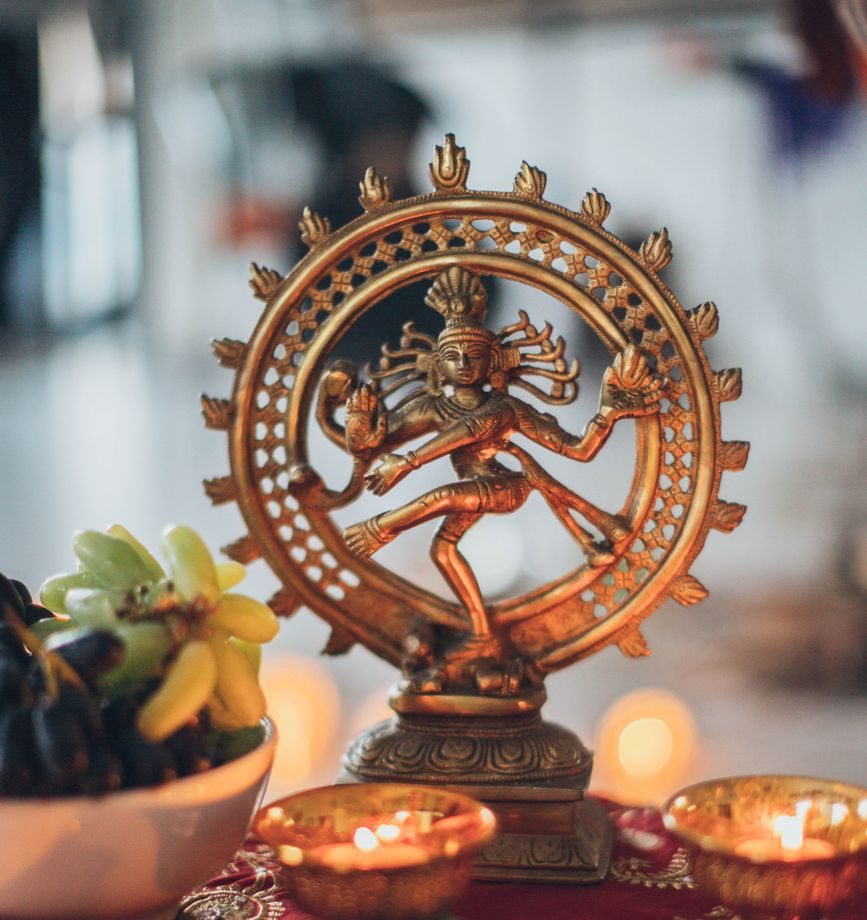
Natarajasana, Dancer Pose, takes us to Shiva in his form as Nataraja — the cosmic dancer.
Shiva’s dance represents the universe’s constant movement: creation, preservation, and destruction, all happening within an endless cycle.
We try to become steady, but the body is never actually still. We’re making tiny adjustments all the time. We lose our balance, find it again, wobble, breathe, and carry on.
The pose becomes a small reminder of something much bigger: that change is not an interruption to life. Change is an essential part of life.
What I love about bringing the stories onto the mat
For me, the point isn’t to find one correct interpretation of an asana.
I don’t think you need to know the mythology before you can practice a posture, and knowing the story doesn’t necessarily make the pose more meaningful.
But it can give us another way in.
A story can make us curious about a posture we thought we already knew. It can give us an image to hold in the mind while we’re balancing. It can make us think differently about strength, devotion, courage, transformation, or surrender.
And it reminds us that yoga has always been about so much more than the physical practice.
We’ll keep exploring that alongside the Yamas and Niyamas this month, too. The ethical and philosophical teachings of yoga give us another way of asking what happens on the mat, and what happens when we take the practice off it.
These questions are part of what keeps yoga interesting for me. The physical practice gives us somewhere to explore them.


Leave a Reply