
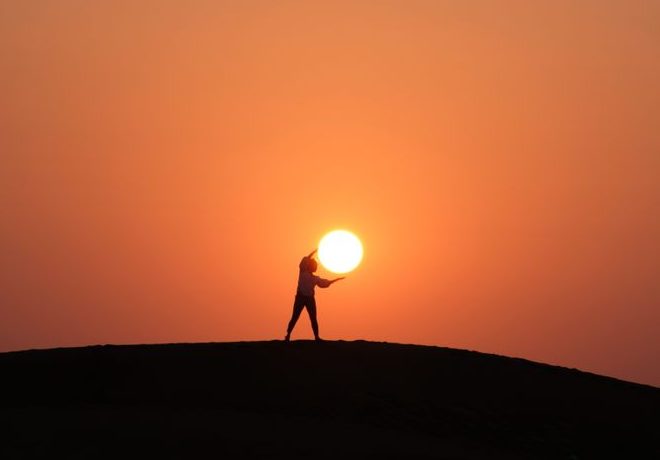
This month’s theme is emerging in part out of need on my behalf 🙂
I’m settling into Portugal, getting accustomed to the rhythms of a new home, and about to meet my first real Portuguese heatwave. I’m trying to stay connected to the practice and community that have shaped so much of my life over the past few years, while also beginning to build new routines and to embrace a new way of teaching that can span countries.
There is a lot of energy, excitement, and possibility, but there is also the very real feeling of being asked to digest and mobilize a huge amount of change at once. In Ayurveda, India’s traditional system of medicine and one of yoga’s sister sciences, this would be considered a very Pitta moment (more on Pitta and the two other doshas below). Not only because summer is Pitta season, but because Pitta is the energy of transformation. It is the fire that helps us metabolize experience, take an idea and make it real, move through change, make decisions, commit to a path, and integrate the lessons of our experiences.
At the same time, change itself is often associated with Vata, the dosha of movement, creativity, and the nervous system. As someone whose constitution tends strongly toward Vata, I know how easy it can be to become swept up in the excitement of a new chapter while also feeling untethered by it.
Perhaps this is why Ayurveda feels so helpful to me at moments like these. Rather than asking us to suppress or resist the qualities that arise within us, it invites us to cultivate balance. Balanced Pitta gives us clarity, courage, discipline, and the capacity to transform. Balanced Vata brings creativity, adaptability, and openness to new experiences.
That said, as yoga and Ayurveda teach us, we need balance in order to thrive in concert with our circumstances and the elements. Diving too eagerly into any one aspect of ourselves is not sustainable. As such, this month will be dedicated to finding balance amidst an onslaught of fiery energy.
Working with the Doshas
Even without a recent move to contend with, this is often a time of year when I feel pulled in many directions at once. Part of me wants to say yes to everything. To swim in the sea, stay outside until sunset (yes, sunset. Sunrise is no longer within my conceivable realm of possibilities :)), start new projects, visit new places, catch up with friends, and squeeze every possible drop out of these long days. Another part of me knows that if I do all of those things at full intensity, I will eventually find myself feeling scattered, overheated, impatient, and tired.
Ayurveda has a language for this.
Ayurveda is built upon the understanding that the five elements—earth, water, fire, air, and ether—exist both in nature and within us. They influence our physiology, energy levels, emotions, and the ways we respond to the world around us.
These elements combine to create three doshas, or constitutional energies.
Vata, composed of air and ether, governs movement, creativity, inspiration, and the nervous system.
Pitta, made of fire and water, governs transformation. It is responsible for digestion, metabolism, focus, ambition, intellect, and our ability to turn ideas into action.
Kapha, made of earth and water, provides structure, grounding, stability, patience, and endurance.
None of these energies is inherently good or bad. We need all three. The question Ayurveda asks is simply: what do we need more of right now, and what might we have too much of? How can we work with what is available to us to create a greater sense of balance?
And as you may have experienced yourself during this year’s fierce introduction to summer across Europe, too much Pitta might show up as irritability, inflammation, disrupted sleep, digestive issues, competitiveness, perfectionism, frustration, or that feeling of always being “on.”
Ayurveda approaches imbalance through what is known as the principle of opposites: like increases like, and opposites restore balance.
If life feels hot, intense, and overstimulating, the answer isn’t necessarily to stop moving altogether. Instead, we look for practices that introduce qualities such as softness, steadiness, spaciousness, coolness, and ease.
This is where our practice comes in.
Classes designed to harness and balance the fire within
July’s classes will still be dynamic. Summer isn’t the season for retreating completely inward. There is a natural expansiveness available to us right now, and I don’t want to lose that. I want us to enjoy it.
So while this month’s theme is partly about cooling Pitta, I don’t want to frame Pitta as something we simply need to calm down or get rid of. When in balance, Pitta gives us clarity, courage, discipline, intelligence, an appetite for life, and the ability to transform. Without it, we might dream endlessly but never act. The work, especially in the heat of summer, is not to extinguish that fire, but to tend it carefully enough that it continues to support us rather than burn us out.
Our practices this month will still have movement, flow, and strength. We’ll build enough heat to feel energized, but not so much that we leave class feeling overstimulated. Forward folds will become something of a recurring theme. Ayurveda often recommends side bends, twists, and cooling forward folds during summer because they help release excess heat held in the torso and soothe the nervous system. Wide-legged folds, Janu Sirsasana, Upavistha Konasana, Paschimottanasana, and supported variations will make regular appearances.
We’ll pair these with gentler heart-opening postures designed to create spaciousness across the chest, supported bridge, sphinx, and seal among them.
Embracing the fullness of summer with an open heart
Traditional Chinese Medicine offers another perspective on summer that feels beautifully complementary to Ayurveda.
In TCM, summer is associated with the Heart. The heart isn’t viewed only as a physical organ but as the energetic centre of joy, excitement, love, creativity, passion, and meaningful connection. To nourish the heart, TCM encourages us to seek out activities that feel genuinely enjoyable, wake early with the sun, spend time outside, nurture creative projects, and play more.
TCM also associates the heart with the colour green, which feels fitting at a time of year when nature seems to be offering us exactly what we need. Green landscapes, green foods, and green spaces that invite us to slow down.
After all, most of us spend the overwhelming majority of our lives indoors. Our ancestors lived in direct relationship with changing seasons, shifting daylight, seasonal foods, and natural rhythms. The amount of morning light we receive, the foods we eat, the hours we sleep, the kinds of movement we choose, and the people we spend time with all send information to the body. They tell us what season it is and whether it is time to mobilise energy or conserve it.
Summer naturally encourages more movement, more connection, and more sociability, but traditional Ayurvedic teachings also remind us that summer movement was historically low-intensity and sustained rather than maximal.
Creating space to let it land
As such, many of our practices will close with longer periods of restoration, guided meditation, cooling pranayama, or Yoga Nidra, because transformation requires rest if it is going to be sustainable. We’ll work with Sheetali breath and left-nostril breathing, imagine ourselves beneath the shade of trees or beside cool water, and let the body receive the message that it does not always have to brace for what comes next.
My hope is that these practices help us stay connected to summer’s brightness without being consumed by it, and that we can use this season’s fire to transform in ways that feel aligned, nourishing, and sustainable. This month, we will work with what’s available to us, learn to trust our instincts, and remember that balance rarely looks the same for everyone. We all need different things to feel truly nourished, and I hope to offer a space that allows you to explore that on your own terms.


Leave a Reply