Years ago, I read something by Ursula K. Le Guin that has stayed with me, and that I was delighted to see highlighted recently in one of my favourite newsletters.
In The Lathe of Heaven, one character speaks to another about our fear of change and the illusion of safety. He says:
“You are afraid of losing your balance. But change need not unbalance you; life’s not a static object, after all. It’s a process. There’s no holding still. Intellectually, you know that, but emotionally, you refuse it. Nothing remains the same from one moment to the next; you can’t step into the same river twice. Life — evolution — the whole universe of space/time, matter/energy — existence itself — is essentially change… When things don’t change any longer, that’s the end result of entropy, the heat-death of the universe. The more things go on moving, interrelating, conflicting, changing, the less balance there is — and the more life.”
And later, almost as a dare:
“You can’t try to live safely, there’s no such thing as safety. Stick your neck out of your shell, then, and live fully.”
There you have it. And wow, I think this is worth revisiting often, more than ever at the start of a new year.
With a blank slate at our disposal, we are told to set firm intentions and create a sense of control over what’s coming. “Control” in this sense is always an illusion, though. So, this January, I’m inviting you to do the opposite.
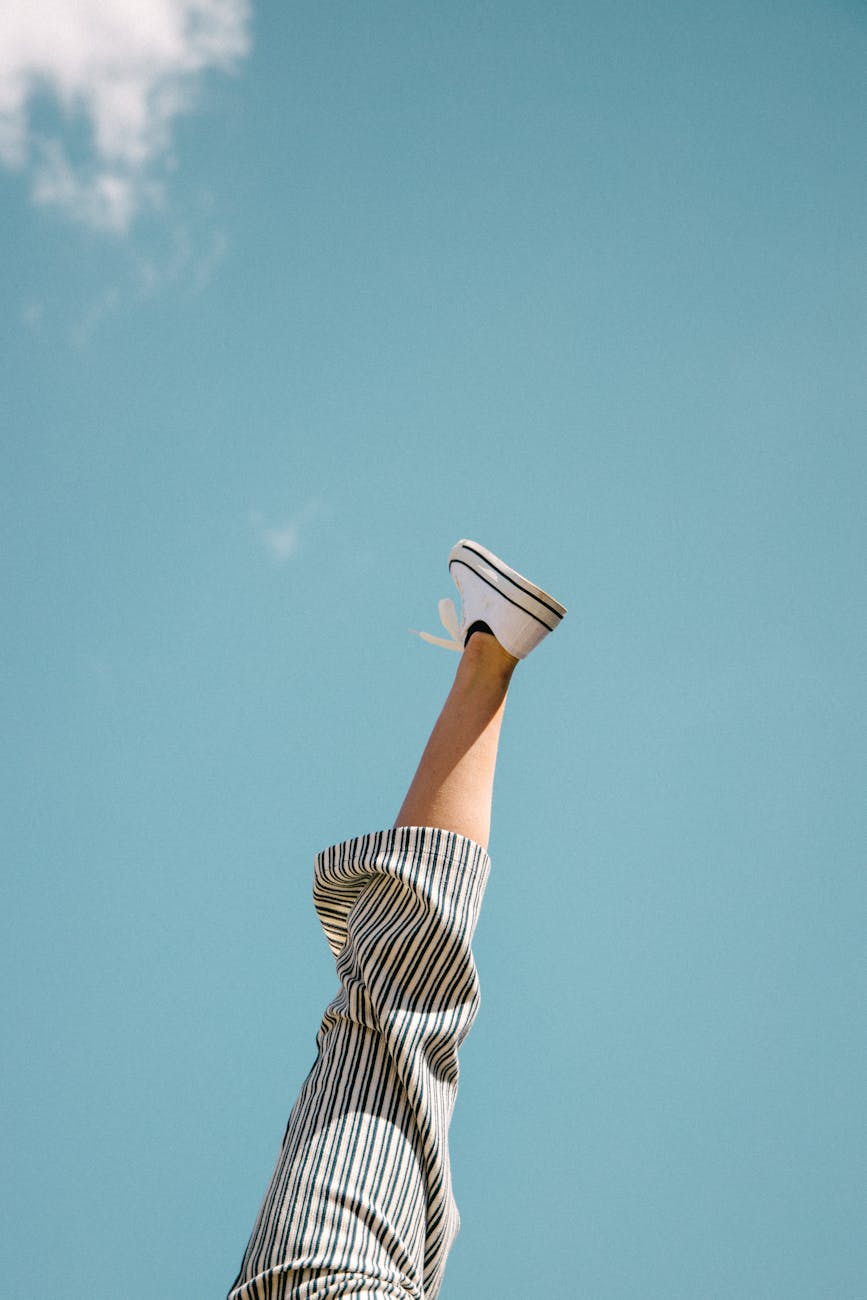
Our theme for this month is inversions. I want to explore them as a practice in perspective, uncertainty, and trust.
What inversions teach us
Wherever one finds themself on their inversion journey, they will be able to appreciate that there’s something inevitably revealing about going upside down.
When your heart is above your head, you can’t multitask or drift into autopilot. As such, inversions are one of the quickest ways I know to understand where my nervous system is actually at. Some days I feel light and buoyant. On other days, my body feels heavy and uncooperative.
Both experiences are informative, and I have learned to love inversions for this reason. They show me my relationship to effort, fear, patience, and control. They also highlight how attached I am to outcomes and teach acceptance by forcing me to acknowledge: This is where I am today, and I can work with that.
Strength, effort, and letting go
Because combining balance and inversion requires effort. I’m very much still learning how to inhabit my body in a way that feels good when I’m upside down. To tackle certain inversions with confidence, building a strong core and upper body is essential. Say hello to planks, push-ups, boat pose, and leg raises.
Even with all the preparation, though, some days the body says no, and the practice becomes about listening instead of pushing and maybe opting for something restorative.
Because on a very practical level, inversions shift our internal landscape.
When we place the heart above the head, we alter blood flow and support what’s called venous return, the amount of blood returning to the heart. This can gently encourage the heart rate to slow and often creates a sense of steadiness, even during intense practice.
Inversions also support the lymphatic system by promoting fluid movement, reducing inflammation, and enhancing immune function. Increased blood flow to the brain may positively affect mood and focus by stimulating regions associated with emotion regulation and balance.
Which brings me to an important point:
Inversions can be gentle and restorative.
We often hear the word “inversion” and immediately picture headstands, forearm stands, handstands, the shapes that dominate social media and studio conversations.
But inversions are simply postures where the heart is above the head, or the hips are above the heart. Downward Dog. A supported Shoulderstand. Viparita Karani, Legs Up the Wall, which, fun fact, literally translates to “the action of reversing.”
This matters because not everyone should (or wants to) be upside down in the same way.
High blood pressure, heart conditions, pregnancy, recent eye or dental surgery, head colds, neck issues, all of these are valid reasons to modify or opt out. None of these choices are failures and exercising agency to choose the right option for you speaks to the awareness we aim to cultivate.
Reversal as a yogic principle
Philosophically, inversions are a physical expression of something yoga has always been asking us to do: noticing (and potentially shifting) our habitual patterns.
Patanjali calls this pratipaksha-bhavana: cultivating the opposite. When fear arises, we practice courage. When grasping appears, we practice letting go. When the mind spirals outward, we guide it gently back in.
And inversions reverse our literal orientation to the world, asking us to see from a place that’s unfamiliar, unstable, and potentially clarifying.
Life will turn us upside down whether we practice inversions or not.
Plans shift. Certainty dissolves. The ground we thought was stable suddenly isn’t. Inversions provide a context for rehearsing how we respond when that occurs.
Can we stay present when things feel unfamiliar?
Can we breathe when we don’t know the outcome?
Can we trust ourselves to adapt instead of freeze?
Sometimes the answer might look like finally catching a few moments of stability in a head or handstand. Sometimes it looks like lying on the floor with your legs up the wall, doing absolutely nothing, and letting that be enough.
So this month, we’ll explore inversions as tools for inquiry. For perspective. For learning how to stay with ourselves when things shift.
Heart over head.
Presence over performance.
Curiosity over control.
And maybe discovering a little more life along the way 🙂


Leave a comment